A daily gut routine for regularity and comfort
Most of what keeps digestion on schedule is unglamorous: enough fiber, enough fluid, a body that moves, and meals at about the same time each day. This entry turns that into a routine you can run, with the numbers from FDA labeling rules, NIH guidance, and the trials behind each habit, then reads the script viral gut-supplement ads follow.
Healthy adults whose schedule slips now and then. It is not built for anyone already under care for a digestive problem, and it doesn't replace a clinician. Skip the self-experiment and get checked if bowel habits shift for the first time after 50, if a change hangs on for weeks even with these habits in place, or if it comes with bleeding, fever, vomiting, trouble swallowing, or abdominal pain that is severe or getting worse.
The routine at a glance
-
Close the fiber gap, slowly
The average American eats about 16 grams a day; NIDDK's adult target is 22 to 34. Add 3 to 5 grams at a time, food first.
-
Pair every added gram with fluid
Fiber without water can firm things up instead of softening them. Drink with meals and with any fiber dose.
-
Walk most days
Twenty to thirty minutes counts. Taken after a meal, it stacks with step four.
-
Eat breakfast and protect a morning window
The colon is most active after waking and after meals; a real breakfast plus an unhurried 15 to 45 minutes afterward works with that.
-
Judge it at four weeks, not four days
In pooled fiber trials, gains in frequency showed up in studies lasting four weeks or more. Keep a one-line daily note.
Fiber: the numbers FDA and NIH actually use
When FDA rewrote the Nutrition and Supplement Facts labels in 2016 it defined "dietary fiber" for the first time: non-digestible carbohydrates naturally present in plants, plus isolated or synthetic ones FDA has judged to have a physiological benefit. The Daily Value on labels is 28 grams. Psyllium husk is on FDA's list of isolated fibers that meet the definition; inulin and inulin-type fructans are on a second list FDA intends to add and meanwhile lets manufacturers count as fiber. That is a labeling status, not a verdict on how well either works.
On intake, the National Institute of Diabetes and Digestive and Kidney Diseases (NIDDK) sets the adult target at 22 to 34 grams a day by age and sex, says to raise it gradually, and tells readers to drink plenty of liquids so the fiber can do its job. MedlinePlus, from the NIH's National Library of Medicine, puts the U.S. average near 16 grams against a 21-to-38 recommendation and warns that a fast jump brings gas and cramping that fades as gut bacteria adjust. It also draws the line that matters next: soluble fiber pulls in water and gels; insoluble fiber adds bulk and speeds passage.
Psyllium and inulin are not the same fiber
Psyllium is the ground seed husk of Plantago ovata: soluble, gel-forming, and barely fermented, so it keeps holding water through the large bowel instead of being consumed by bacteria early. A two-part review in Nutrition Today, written by a scientist employed by a company that sells a psyllium supplement, argues that these physical traits, not the word "fiber," predict what a supplement does. FDA treats psyllium husk as a recognized soluble fiber: 21 CFR 101.81 ties an authorized heart-health claim to 7 grams or more a day of soluble fiber from psyllium husk (at least 1.7 grams per serving) and requires the husk to be at least 95 percent pure.
For regularity, psyllium is the supplement fiber with the most consistent trial support. The most recent pooling of randomized trials, published in 2022 and covering 16 studies and 1,251 adults with chronic constipation, found two-thirds of fiber users responded versus about two in five on control, with psyllium and pectin carrying the statistically significant effects. Stool frequency improved mainly above 10 grams a day kept up for four weeks or longer, consistency improved, and gas was more common on fiber. Results varied widely, and a 2016 pooling of seven trials pointed the same way but rated the evidence low quality. Real effect; imperfect studies.
Inulin is a different ingredient with a different mechanism: a fructan, usually from chicory root, that bacteria ferment quickly, which produces gas and underpins the "prebiotic" label. A 2014 pooling of five randomized trials (252 participants) found inulin raised stool frequency, improved consistency, and shortened transit time but didn't help pain or bloating. A 2017 double-blind crossover trial gave 44 volunteers with sluggish bowels 12 grams a day for four weeks; median weekly stools rose to 4.0 from 3.0 on placebo, with softer stools. Modest, real, and run with the manufacturer's research institute involved. Neither works overnight the way a stimulant laxative does, and neither was tested in people whose habits were already regular.
Water: the part the fiber trials quietly depended on
You won't find an eight-glasses rule at NIDDK; it sends readers to a health professional for a personal figure. What it does say plainly is that liquids help fiber do its work. One small, old trial tested that directly. In 1998, 117 adults aged 18 to 50 with chronic functional constipation ate a diet supplying about 25 grams of fiber a day for two months; half drank freely (averaging 1.1 liters a day) and half were told to drink 2 liters of mineral water (averaging 2.1). Both groups went more often and used fewer laxatives, and the higher-fluid group improved significantly more on both counts. Small, old, and impossible to blind, but a direct test of extra fluid on top of the same fiber intake.
Psyllium adds a safety reason. Konsyl's label, like other psyllium products, tells you to take it with at least a full glass of liquid (8 fluid ounces) and drink it right away, because without enough fluid it can swell and block the throat or esophagus, and to skip it if you have difficulty swallowing. MedlinePlus also advises keeping digoxin, aspirin-type salicylates, and nitrofurantoin three hours away from a psyllium dose, and checking with a clinician first if you have trouble swallowing or a history of intestinal blockage.
Walking: cheap, boring, and consistently pointing the same way
The observational picture is large. A 2024 review pooling 13 cohort studies and 119,426 participants found higher physical activity went with a lower risk of irregularity (relative risk 0.69 versus low activity), and simply meeting activity guidelines went with roughly 13 percent lower risk. Cohorts can't prove cause. The trial evidence is smaller: a 2019 meta-analysis of nine randomized trials (680 participants) found exercise, mostly walking, qigong, and general movement, roughly doubled the chance of symptom improvement, while the authors warned the trials were biased enough that the true size can't be pinned down. Consistent direction, uncertain magnitude, zero cost. A 20-to-30-minute walk most days, ideally after a meal, is the version worth running.
Meal timing: work with the colon's clock
In a 2001 study, 25 healthy adults wore a pressure-sensing probe in the colon for 24 hours while living normally. Colonic activity dropped at night, roughly tripled on waking, and roughly doubled after meals; the strong propagating waves that move contents along, about ten a day, clustered after waking, after meals, and around bowel movements.
NIDDK's bowel-training advice follows directly: aim for the same time each day, for instance 15 to 45 minutes after breakfast, because eating prompts the colon to move stool, and allow enough time. In practice: eat an actual breakfast (skipping it skips the signal), keep a short unhurried window afterward, and don't postpone the urge when it comes.
Coffee earns a footnote: in a 1990 study, both regular and decaf coffee raised lower-colon activity within four minutes in the eight of 14 volunteers who called themselves responders, while hot water did nothing. Real for some people, not about the caffeine, not universal.
What the viral gut-supplement ads claim, and why it doesn't follow
Most "gut" products in social feeds are sold with the same script. Here it is, paraphrased, with the missing piece in each line. No product or person is named; the pattern is what matters.
- The single hidden causeOne villain (a parasite, a "toxic" gut lining, one overgrown bacterium) that only this formula handles. NIH guidance lists ordinary, plural contributors instead: low fiber, low fluid, inactivity, ignoring the urge, certain medications.
- The "suppressed" ingredientA root or berry that doctors supposedly hide. The ingredients tested for regularity sit in public FDA documents and on PubMed, and the best-studied one costs cents a serving.
- The proprietary blendMany ingredients under one blend total, no per-ingredient amounts. The pooled trials saw clear effects above 10 grams of fiber a day; a capsule holds well under a gram. A label that hides amounts can't be compared to any study, which is usually the point.
- "Studies show"Borrowed science. Ask whether the study tested this product, at this dose, in people like you, or one ingredient at an amount the product can't contain. A citation you can open is the minimum.
- "Made in an FDA-registered facility"Registration is a manufacturing requirement, not a product review. FDA has no authority to approve supplements before they're sold and doesn't approve their labeling; the company is responsible for its own safety and claims.
- The "doctor" in the videoAn AI-generated or dubbed presenter in a white coat with no checkable name or license, or a real clinician's likeness used without permission. A face you can't verify is not evidence.
- The instant testimonialResults in days. The trials measured modest changes over four or more weeks.
A fair product is easy to spot once you know the script: one or two named ingredients, grams per serving on a Supplement Facts panel, a third-party certification you can look up, directions that mention fluid, and a per-serving price you can compute.
If you want a fiber supplement: a plain option that checks out
We looked for the least complicated version of what the trials used: single-ingredient psyllium husk powder with a real Supplement Facts panel, sold by its maker, with a certification we could check ourselves. Konsyl Daily Psyllium Fiber in the 19-ounce (540 g) pouch, 90 servings, fits.
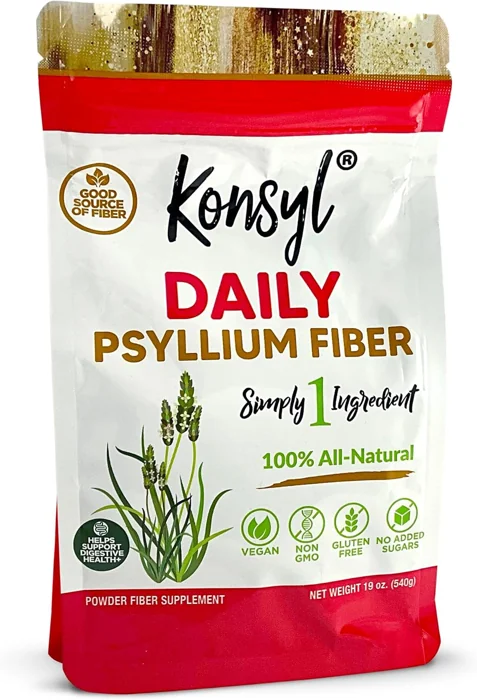
| Ingredient | Powdered psyllium husk and nothing else; no sugar, flavors, dyes, or preservatives. |
|---|---|
| Serving | One teaspoon (6 g) delivers 20 calories and 5 grams of dietary fiber, 3 grams of it soluble, per the Supplement Facts panel shown on the listing. |
| Directions | Adults and children 12 and over: one teaspoon one to three times a day, mixed with at least 8 fluid ounces of liquid and drunk immediately. The label gives no ramp-up schedule; NIDDK's advice to add fiber a little at a time is the sensible default. |
| Dose vs. the trials | One teaspoon is half the roughly 10-gram-a-day level above which pooled trials saw clear effects; the label's two to three servings a day is what gets you there. |
| Label notices | The pouch is made for Konsyl Pharmaceuticals (Easton, Maryland) and labeled a product of India. It carries an allergy alert for people sensitive to psyllium and a California Proposition 65 notice about lead, a notice that is common on psyllium products. |
| Certification | NSF Contents Certified. On October 7, 2026, NSF's public NSF/ANSI 173 directory listed Konsyl's Daily Psyllium Fiber powder (all sizes) with a one-teaspoon (6 g) serving. That verifies the label's contents and screens for contaminants; it doesn't speak to results. |
| Price and seller | $25.99 on Amazon, seen October 7, 2026, about $0.29 a serving. In stock, shipped by Amazon, seller Konsyl Pharmaceuticals Inc. Amazon flags it as not returnable (food safety). |
Prefer capsules to a powder? The main site's entry on NOW Foods psyllium husk capsules covers that route.
Plain link: Konsyl Daily Psyllium Fiber, 19 oz, on Amazon
As an Amazon Associate we earn from qualifying purchases. It doesn't change your price or what's written above; see our Disclosure.
A realistic day
Oatmeal or whole-grain toast with fruit and a glass of water; a teaspoon of psyllium in a full glass if you use one, kept well apart from your medications (three hours for the ones MedlinePlus names); an unhurried bathroom window after breakfast; a walk at lunch or after dinner; beans or vegetables at the main meals with water alongside; one line in a notebook at night. Run it for four weeks before judging it. None of this research measured a single great day.
Where this comes from
- U.S. Food and Drug Administration. Questions and answers on dietary fiber (definition, the fibers that meet it, and the fibers FDA intends to add, including inulin). fda.gov
- U.S. Food and Drug Administration. Daily Value on the Nutrition and Supplement Facts labels (dietary fiber: 28 g). fda.gov
- 21 CFR 101.81, soluble fiber from certain foods, including 7 g/day of soluble fiber from psyllium seed husk and the 95 percent purity requirement (via GovInfo). govinfo.gov
- U.S. Food and Drug Administration. Questions and answers on dietary supplements (FDA does not evaluate supplements or their labeling before sale). fda.gov
- NIDDK. Treatment guidance, including bowel training 15 to 45 minutes after breakfast. niddk.nih.gov
- NIDDK. Eating, diet, and nutrition guidance (22 to 34 g fiber; liquids help fiber work). niddk.nih.gov
- MedlinePlus (NIH). Dietary fiber overview: soluble vs. insoluble; U.S. average about 16 g/day. medlineplus.gov
- MedlinePlus (NIH). Psyllium: directions, fluid requirement, and three-hour spacing from certain medicines. medlineplus.gov
- van der Schoot A, et al. Pooled analysis of 16 randomized fiber-supplement trials in 1,251 adults. American Journal of Clinical Nutrition, 2022. PMID 35816465. pubmed
- Christodoulides S, et al. Pooled analysis of seven fibre-supplement trials; evidence graded low quality. Alimentary Pharmacology & Therapeutics, 2016. PMID 27170558. pubmed
- McRorie JW. Review series on the physical properties of fiber supplements, part 1. Nutrition Today, 2015. PMID 25972618. pubmed
- Collado Yurrita L, et al. Pooled analysis of five randomized inulin trials, 252 participants. Nutrición Hospitalaria, 2014. PMID 25208775. pubmed
- Micka A, et al. Double-blind, placebo-controlled crossover trial of 12 g/day chicory inulin for four weeks in 44 volunteers. International Journal of Food Sciences and Nutrition, 2017. PMID 27492975. pubmed
- Anti M, et al. Randomized trial of 2 L/day fluid added to a 25 g/day fiber diet in 117 adults over two months. Hepato-Gastroenterology, 1998. PMID 9684123. pubmed
- Cui J, et al. Review of 13 cohort studies (119,426 participants) on physical activity and bowel regularity. Journal of Global Health, 2024. PMID 39575759. pubmed
- Gao R, et al. Meta-analysis of nine randomized exercise trials (680 participants). Scandinavian Journal of Gastroenterology, 2019. PMID 30843436. pubmed
- Rao SS, et al. 24-hour ambulatory colonic manometry in 25 healthy adults (waking and meals increase colonic motor activity). American Journal of Physiology: Gastrointestinal and Liver Physiology, 2001. PMID 11254489. pubmed
- Brown SR, Cann PA, Read NW. Effect of coffee on distal colon function (99 volunteers surveyed; 14 studied with manometry). Gut, 1990. PMID 2338272. pubmed
- Konsyl Pharmaceuticals. Konsyl Daily Psyllium Fiber product page (6 g scoop, at least 8 oz of liquid, drink immediately). konsyl.com
- NSF. Certified dietary supplement listings (NSF/ANSI 173) for Konsyl Pharmaceuticals, Inc. Accessed October 7, 2026. info.nsf.org
- Amazon product listing for Konsyl Daily Psyllium Fiber, 19 oz, as seen October 7, 2026 (price, seller, stock, returns). amazon.com
Summarized here in plain language. Read the originals, or talk to a healthcare provider, before applying any of it to your own situation.
Content on this site is for general informational purposes only and is not medical advice. It is not intended to diagnose, treat, cure, or prevent any disease or condition. Talk to a healthcare provider before starting any new supplement or making a significant change to your diet or routine, especially if you're pregnant or nursing, take other medications, have trouble swallowing, or manage a chronic digestive or kidney condition.